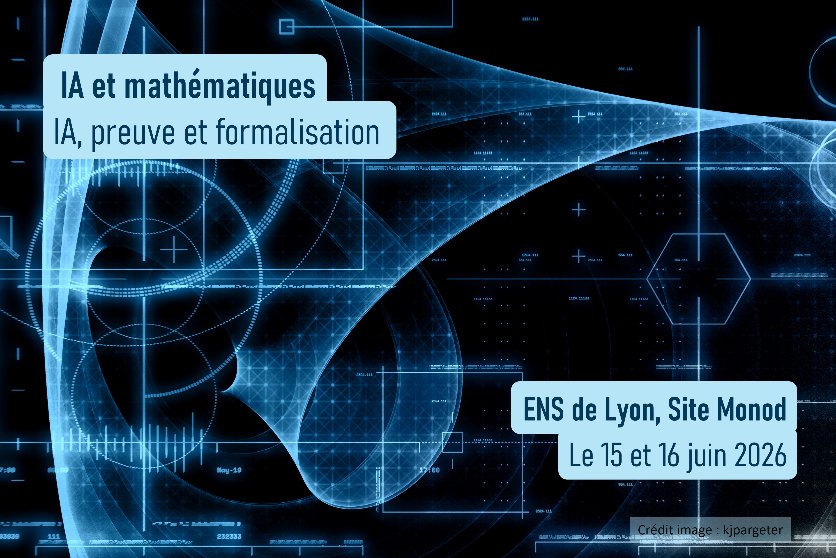
AI, Proof and Formalization Days
A two-day workshop on how artificial intelligence — especially large language models — is reshaping mathematical work, from proof-oriented reasoning to writing, idea exploration, bibliographic research, formalization, and autoformalization.
Held on June 16–17, 2026
ENS de Lyon, Monod campus, Lyon
The workshop brought together a broad audience from mathematics and computer science, with more than 70 registrations. It combined critical accounts of current LLM-assisted mathematical practice with hands-on sessions and research talks on proof assistants, formalization, and autoformalization.
Slides and public repositories made available by the speakers are linked from the program below.
- Date: June 16–17, 2026
- Venue: ENS de Lyon, Monod campus
- Address: 46 allée d’Italie, 69007 Lyon
- Official url: AIlys.
About the workshop
The meeting examined the current use of artificial intelligence — in particular large language models (LLMs) — in mathematical practice. The first day focused on what these tools can contribute to mathematical reasoning and to the broader working environment of mathematicians: exploring ideas, sketching arguments, drafting text, searching the literature, and assisting with proof development.
The second day was devoted to formalization with proof assistants, including practical introductions to Rocq and Lean/Mathlib, a hands-on session on autoformalization, and research talks on large-scale formal mathematics. Throughout the workshop, formalization was considered both as a scientific practice fostering rigor, explicitness, and reproducibility, and as a possible verification layer for AI-assisted mathematics.
The workshop also addressed the structural limitations of generative systems — hallucinations, fragile chains of reasoning, and the absence of formal guarantees — together with the conditions for their responsible and informed use.
Main themes
- Use of LLMs for mathematical reasoning and the semi-automatic construction of proofs.
- Impact on mathematical work: idea exploration, argument sketches, writing support, and bibliographic research.
- Critical assessment of hallucinations, fragile reasoning, and the lack of formal guarantees.
- Formalization with Rocq and Lean, and its relation to trustworthy mathematical workflows.
- Autoformalization and the interaction between language models and proof assistants.

Program, abstracts, and materials
Click “Abstract” to display a talk description. Slides and repositories are included when publicly available.
Day 1 — Tuesday, June 16, 2026
| Time | Speaker / session | Title, abstract, and materials |
|---|---|---|
| 9:45–10:45 | Mathurin Massias |
An introduction to Transformers and LLMs
AbstractThis talk is meant as a broad introduction to the field of LLMs, aiming to provide the audience with a common basis for the rest of the workshop. I will introduce the Transformer architecture for sequence modelling, in particular its attention mechanism. I will then present the broader use of Transformers as large language models, including text tokenization, next-token prediction, model training, and fine-tuning. |
| 11:15–12:15 | Omar Fawzi |
New combinatorial constructions via program search with LLMs
AbstractI will describe the FunSearch methodology — short for searching in the function space — a procedure based on pairing a pretrained LLM with a systematic evaluator, and illustrate how it can be used to search for interesting combinatorial constructions, such as large cap sets. The talk will be mostly based on the 2023 Nature paper on FunSearch. |
| 12:15–14:00 | Lunch break | Lunch buffet. |
| 14:15–15:15 | Ivan Nourdin |
The future of mathematics in the age of AI
AbstractIn this talk, I will look back at the “Malliavin–Stein experiment”, conducted last September with C.-P. Diez and L. da Maia, to explore what AI was able to bring to mathematical research at that time. We will then discuss the mathematical advances enabled by AI since then, before reflecting more broadly on what the future of mathematics might look like in the age of AI. |
| 15:45–16:45 | Frédéric Marbach |
Struggles and Sparks: Daily Math with LLMs
AbstractI will share my experience and personal habits for using LLMs in everyday mathematical research: searching for bibliography, learning new theories, proving theorems, auditing proofs, and reviewing papers. Starting with examples from control theory, I will specifically review the process of proving a theorem achieved through 86 conversations with recent models. The talk will address various ways of interacting with both poor and excellent models, via the web, APIs, and IDEs. |
Day 2 — Wednesday, June 17, 2026
| Time | Speaker / session | Title, abstract, and materials |
|---|---|---|
| 9:00–10:30 | Cyril Cohen | Hands-on session: formalization with the Rocq prover |
| 10:35–12:05 | Xavier Roblot | Hands-on session: formalization with Lean and Mathlib |
| 12:05–13:30 | Lunch break | Lunch buffet. |
| 13:30–15:00 | Theo Stoskopf | Hands-on session: autoformalization |
| 15:30–16:30 | María Inés de Frutos-Fernández |
Formalizing the universal divided power algebra in Lean
AbstractI will present a formalization in the proof assistant Lean of the universal divided power algebra. This is an analogue, in the theory of divided powers, of the classical algebra of polynomials. It is a crucial tool in the development of crystalline cohomology, and it is also used in p-adic Hodge theory to define the crystalline period ring. Given an ideal \(I\) in a commutative ring \(R\), a divided power structure on \(I\) is a collection of maps \(\gamma_n : I \to I\), indexed by the natural numbers, which behave like the family \(x^n/n!\), but which can be defined even if division by factorials is not defined in \(R\). The triple \((R, I, \{\gamma_n\})\) is called a divided power algebra. To any \(R\)-module, one can associate a universal divided power algebra. While working on this formalization project, we uncovered an error in Roby's 1965 construction of the universal divided power algebra, which we repaired by providing an alternative proof inspired by the ideas in Roby's paper. The work discussed in this talk is joint with Antoine Chambert-Loir. |
| 17:00–18:00 | Ahmad Rammal |
Autoformalization of mathematics at research level: AutoformBot and Atlas
AbstractWe present AutoformBot, a multi-agent system for autoformalizing mathematical textbooks in Lean 4. AutoformBot orchestrates LLM agents equipped with formal verification tools, dependency-aware scheduling, and collaborative version control to translate informal textbook prose into machine-checked definitions and proofs. Applied to 26 open-access textbooks, it produces Atlas, a verified Lean 4 library containing over 45,000 declarations and 500,000 lines of code. These results suggest that autoformalizing substantial parts of graduate-level mathematics at scale is becoming technically and economically feasible, opening new perspectives for the verification of both human- and machine-generated mathematics. |
Scientific committee
- Frédéric Déglise (UMPA)
- Stéphane Gaussent (ICJ)
- Philippe Malbos (ICJ)
- Véronique Maume-Deschamps (ICJ)
- Sophie Morel (UMPA)
- Filippo Nuccio (ICJ–LIP)
Venue
The workshop took place at:
ENS de Lyon, Monod campus
46 allée d’Italie
69007 Lyon, France
For questions concerning the workshop or its materials, please contact ailys.coordination@ens-lyon.fr.
Scientific context
The workshop formed part of the scientific strategy being developed around artificial intelligence on the Lyon–Saint-Étienne academic site. In late 2025, the thematic institute Artificial Intelligence: uses, concepts and issues was launched to bring together research on AI and research about AI across the exact sciences, experimental sciences, social sciences, and the humanities within the member and associated institutions of the ComUE.
Its aim is to make visible, deepen, and strengthen AI-related activities across the Lyon–Saint-Étienne site, from the foundational core of AI to its applications, uses, and broader implications. It also promotes collaborative dynamics between academic actors and with the socio-economic world.
This initiative relies in particular on the AILyS project, a consortium bringing together higher-education, research, and health institutions of the Lyon–Saint-Étienne site around AI.